Research
How do we remember what we experience?
Every waking moment, our brain is receiving an intractably large amount of information: what we see, what we hear, what we feel. Somehow it must make sense of all that information and form a representation that can be recalled at a later time that captures what we experienced in a way that is meaningful and useful. We want to understand how populations of neurons represent various aspects of an experience, such as where you were, who you were with, what you ate, and if you would want to go back.
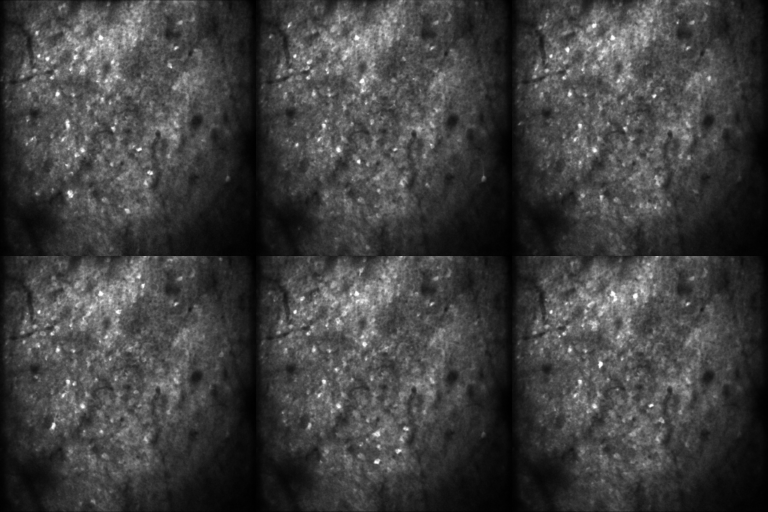
A major challenge turns out to be that some of the most interesting parts of the brain involved in this process are located in anatomically inconvenient areas. Thus, we have worked to devise surgical techniques to access these brain regions using optical imaging. When combined with two-photon imaging and Ca2+ indicators, we can monitor the activity of hundreds of neurons during complex behaviors. In particular, we target the entorhinal cortex, the hippocampus, and the medial prefrontal cortex as they are known to be involved in memory formation. Using virtual reality, we build realistic environments and tasks that engage the sorts of behaviors we use every day, such as finding our way back to our favorite restaurant.